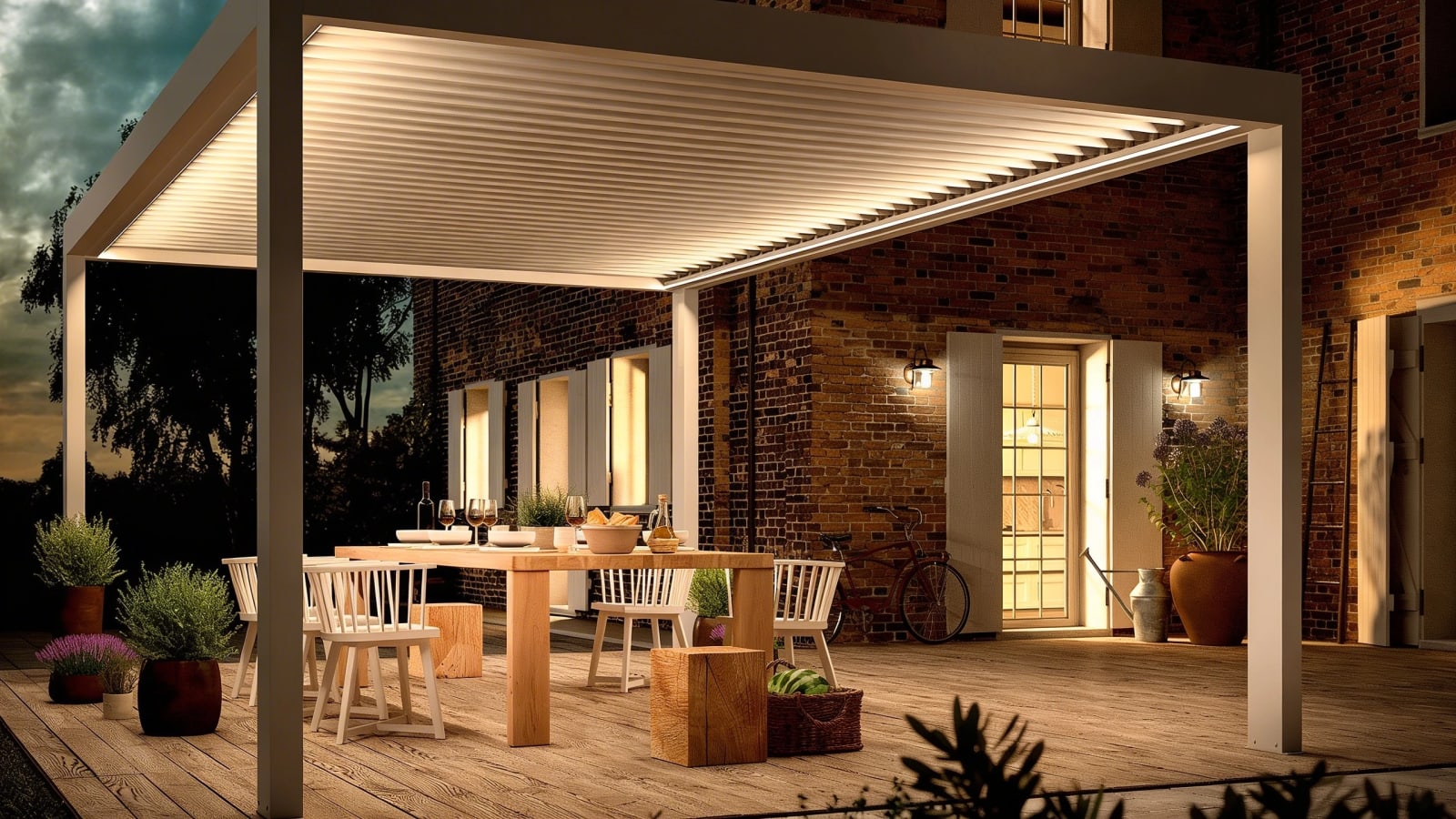
The first question we get with almost every enquiry is the same one: how much is this going to cost. The honest answer is that there is no single price. A bioclimatic pergola is not an off-the-shelf product, it is a structure we build to fit your terrace, and that "made to measure" part is exactly why the final figure varies from one project to the next.
That does not mean you cannot work out roughly which bracket you are in. Below we break down what actually pushes the price up and down, so you can read a quote and know what you are paying for.
Size is the starting point, not the whole story
It seems obvious that a bigger pergola costs more, and it does. But what matters more than square metres is whether you need one module or several. A single module has its limits. With Skymatik, for example, up to 9134 x 4400 mm or 13940 x 1800 mm, depending on the layout. Once your terrace goes beyond that, you need extra modules and posts, which means more material and more work on site.
So two pergolas covering the same area are not necessarily the same price. A long, narrow one often solves with a single module, while a large square one needs an intermediate post or two.
Brand and system class
We work with three brands because each covers a different part of the market. Skymatik, Brustor and Sun Winner are not interchangeable on price. Belgian-made Brustor is known for its robustness and handles extreme snow loads, which shows in the price. Sun Winner S500 goes to the other extreme of engineering. It allows terraces up to 7 x 7 metres without a single intermediate post, which is technically demanding and priced accordingly.
A lower class is not a worse one. It simply means a different structure for different requirements. If your terrace does not need a seven-metre span without a post, there is no reason to pay for one.
Motorisation and smart control
A manually operated pergola is cheaper than a motorised one, but in this class almost nobody chooses manual. The motor is standard. The price climbs with the automation around it. Weather sensors that close the louvres by themselves in rain or wind. Integration into a smart home via KNX. Control through an app. Each of those steps adds its own cost.
With the drive it is worth knowing whose it is. Skymatik, for instance, uses its own drive with Teleco electronics, not a generic one. That affects reliability and servicing over the years.
Louvre profile
The same pergola model can come with a different louvre profile. The standard profile, AGILE at Skymatik, is enough for most typical spans. The reinforced FORTE profile is needed on larger spans, generally from 4001 mm upwards, or as an upgrade when you want higher snow load capacity. If you live somewhere with heavy winters, this is not the place to economise.
Extras that add up quickly
The basic pergola is just the frame. What gives a terrace its character are the extras, and these often lift a quote more than people expect:
- ZIP screen blinds on the sides for protection from wind and prying eyes
- LED lighting in the louvres and RGB ambient lights
- integrated heaters for using the space late into the season
- concealed drainage, built-in speakers, sensors
None of it is essential. But these are the things that separate a pergola you use for three months from one you sit under from April to November.
Installation is not the same everywhere
Two identical pergolas, two different installation prices. A freestanding unit in the middle of a garden goes up differently from one fixed to the facade of a two-storey house with limited access. Preparing the base, access, height and whether the pergola has to tie into an existing structure all affect the work.
Why we cannot give you a price over the phone
Because it would be wrong. Every one of the variables above shifts the figure, and until we know the dimensions, the brand, the level of automation and where the pergola is going, we would be guessing. We would rather take measurements and prepare a quote that holds.
If you want a ballpark, send us the dimensions of your terrace and a few photos. Within 48 hours you will get a non-binding estimate that shows you which bracket you are in, with no surprises later.