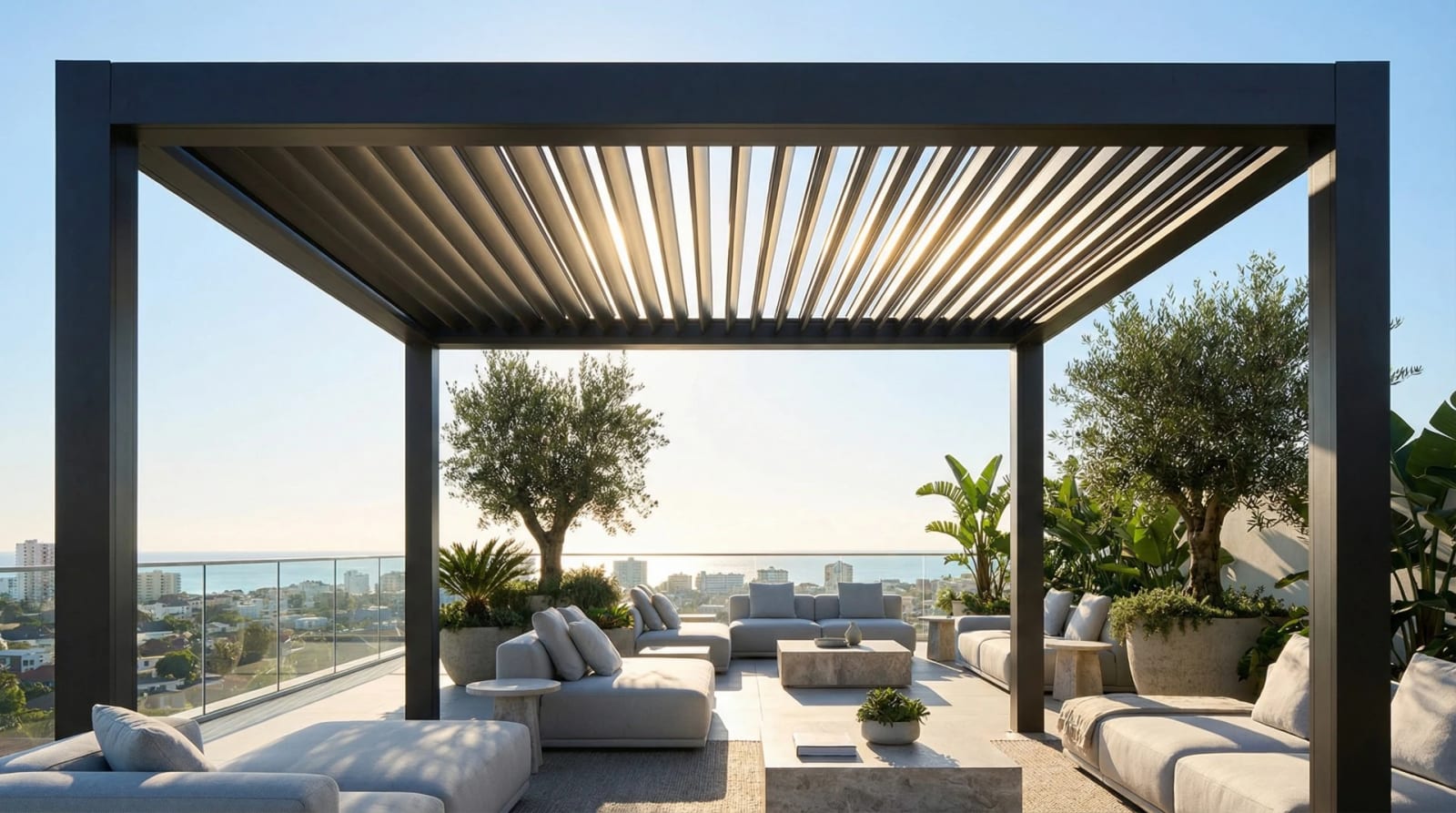
The word sounds more complicated than the thing itself. A bioclimatic pergola is an aluminium structure with rotating louvres in the roof. Instead of a fixed panel overhead you have a row of profiles that you turn to suit the moment. Open them for air and sun, close them for shade or rain.
The name comes from the fact that with the pergola you create your own microclimate on the terrace. You do not fight the weather, you regulate it.
How it works
The heart of the system is the louvres. On modern pergolas they rotate, they do not fold. Skymatik, for example, rotates them up to 140 degrees, which means a whole range of positions between a fully open and a fully sealed roof.
When the louvres are closed, they meet with seals and the roof becomes watertight. Rain runs down the louvres into hidden gutters in the load-bearing profiles, and from there down through the posts. So under the pergola you stay dry in a downpour, and there are no visible drains on the terrace.
When the louvres are open, warm air escapes and cooler air comes in under the roof. This is the difference between a pergola and a glass canopy, under which summer heat builds up with nowhere to go.
A motor drives the whole thing. You control it with a remote or an app, and in more advanced versions sensors close the louvres by themselves at the first drops or in strong wind. If you are not home, the pergola protects itself.
How it differs from a canopy and a pergotenda
Three solutions, three different logics.
A fixed canopy (glass, polycarbonate, wood) is always in the same position. It protects from rain, but in summer a greenhouse effect builds up under glass, and wood takes away light even when you want it.
A pergotenda has a movable fabric that folds away, opening the sky above the terrace completely. That is its strength. The weakness is that the fabric has no in-between positions like louvres, and fabric is still fabric.
A bioclimatic pergola has aluminium louvres with every intermediate position. It does not open the sky all the way, but in return it regulates sun, shade and ventilation at every moment, and lasts considerably longer.
One exception worth knowing: the Brustor B600 S Cabrio can also fold its louvres, so it combines both.
What it is made of
Powder-coated aluminium. The reason is simple. It does not rust, it does not warp, it does not need yearly treatment like wood, and it withstands loads that fabric or plastic could not. The terrace is outside all year, even when you are not using it, and the material has to endure that maintenance-free.
Quality, though, is not in the material itself but in the profiles. Wall thickness, the way sections join, how the sealing and drainage are done. These are the things you do not see in a photo, but you feel them ten years on.
What it can handle
This is where premium systems separate from cheap copies. The louvres of certain models withstand up to 300 kg of snow per square metre. Skymatik states wind resistance up to 230 km/h.
It is important to know that load capacity is not the same at all spans. The larger the span, the more load each louvre carries. That is why Skymatik has two profiles: the standard AGILE and the reinforced FORTE, which is needed from a span of 4001 mm upwards, or as an upgrade when you want more snow reserve. If you live somewhere with heavy winters, this is a question you ask before signing, not after.
Who it pays off for
Honestly: not everyone.
If you only want shade for July and August and do not care how it looks, there are cheaper options. A parasol or an awning will do the job.
A pergola pays off when you want to use the terrace as an extension of the house. Breakfast in the rain. Dinner in September. A space that is usable from April to November, not three months. When it matters to you that in fifteen years it looks the same as on day one. And when you want the terrace to be part of the architecture, not an add-on to it.
A simple test: count how many times a year you did not go outside even though you wanted to. If that number is high, a pergola solves exactly that problem.
Which brands and why three
We work with three because they cover different requirements.
Skymatik is the choice when automation is the priority. Its own drive with Teleco electronics, weather sensors, smart control.
Brustor is the Belgian school of robustness. When conditions are demanding and load capacity is first on the list.
Sun Winner goes in the direction of engineering feats. The S500 model covers a terrace up to 7 by 7 metres without a single intermediate post, which is not feasible with other systems.
Which one is right depends on your terrace, not on which is the most expensive.
Do you need a building permit
For most pergolas up to 20 m2 no, as they count as simple structures. Even so, it is worth checking local regulations, since these differ from one municipality to another. We look at this together with you before installation, so there are no complications later.
How much it costs
There is no single price, because every pergola is made to measure. The price is set by size and number of modules, the chosen brand, the level of automation, the louvre profile and extras. We broke this down in detail in a separate article: how much a bioclimatic pergola costs.
What next
If you are considering a pergola, the most useful next step is to see completed projects. On our references you will find terraces we have built, with a description of what was installed.
When you want a concrete figure for your terrace, send the dimensions and a few photos. Within 48 hours you get a non-binding estimate.