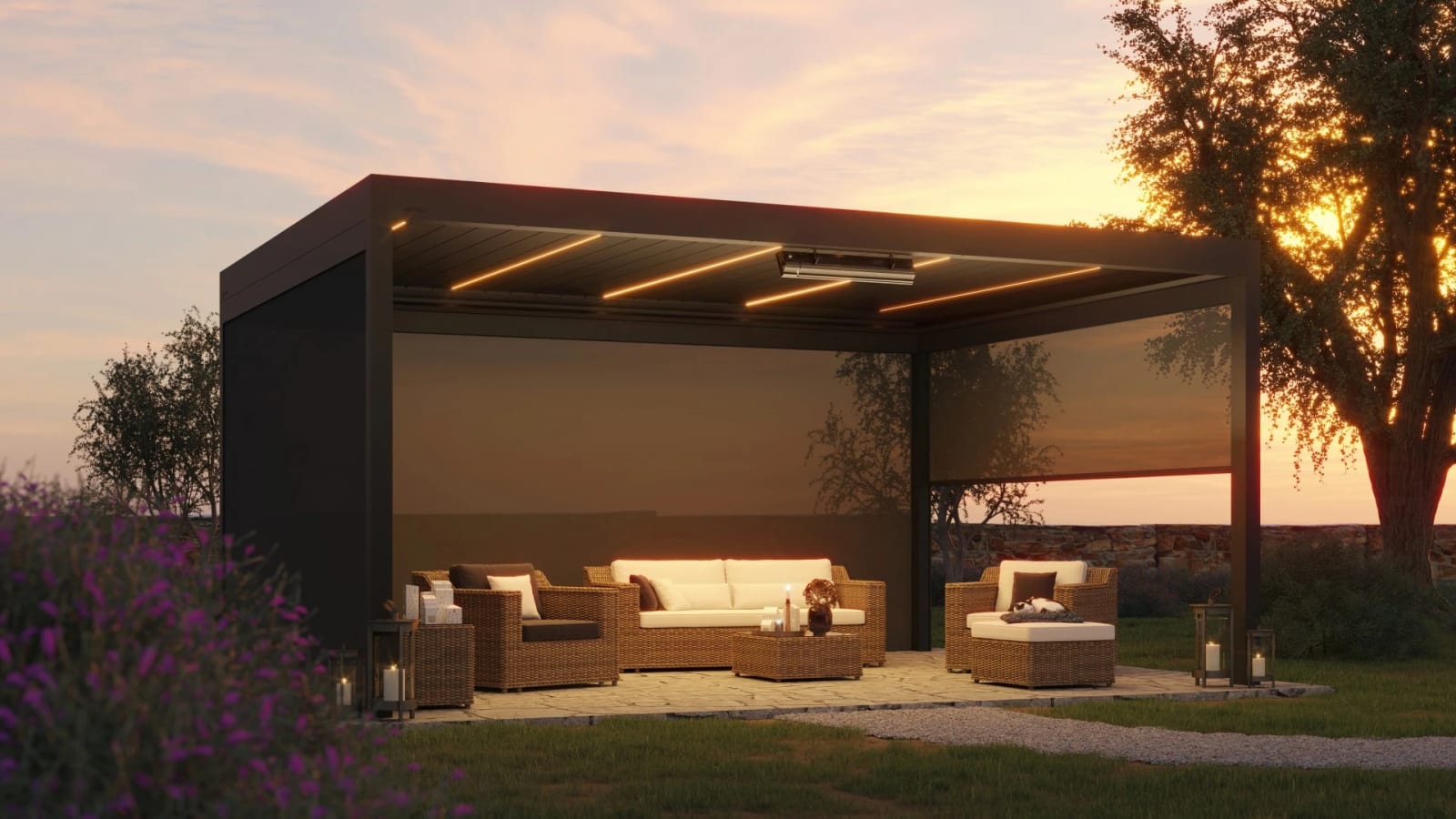
When you start looking into bioclimatic pergolas, you quickly run into three or four names, each presenting itself as the best. The catalogues look alike, the photos even more so, and the real differences hide in things you cannot see in a picture. Since we sell Skymatik, Brustor and Sun Winner, we can tell you what actually separates them, and when each one is the wrong choice.
What follows is not a ranking from best to worst, because no such ranking exists. It is clear, though, which brand solves which problem.
The question that decides the most
Before you look at brands, measure the terrace. The key question is not which pergola looks best, but how large a span you need to cover and whether you can accept a post in the middle.
A long, narrow terrace is solved with a single module by practically any brand. A large square terrace with no post in the middle narrows the field immediately to one or two options. That one constraint often decides more than the entire rest of your wish list.
The second question is climate. Where winters are heavy, snow load capacity matters more than the colour of the frame, and there it pays to buy the reinforced version.
What separates the three brands
A short overview before the details:
| Brand | Origin | What sets it apart |
|---|---|---|
| Skymatik | Italy | Automation, reinforced louvre profile for snow, YETI louvre heating, upgradeability |
| Brustor | Belgium | Widest product range, robustness, a model with fully folding louvres |
| Sun Winner | Poland | Very large spans without an intermediate post, XPS louvre filling, concealed screw joints |
Skymatik: when automation comes first
Skymatik is an Italian system built around the idea that the pergola works instead of you. The louvres rotate up to 140 degrees, giving you the full range of positions between open and fully sealed. With weather sensors they close by themselves at the first drops or in strong wind, even when you are not home.
For snowy regions one detail matters: the louvre profile. The standard AGILE covers typical spans, while the reinforced FORTE is needed on larger spans, generally from 4001 mm upwards, or as an upgrade when you want more snow reserve. The louvres of certain models withstand up to 300 kg of snow per square metre.
Skymatik also offers something you rarely find elsewhere: YETI louvre heating, which melts the snow instead of leaving you to wait for it. If your terrace is in a winter region and you use the pergola year round, that is worth a look.
There are three models in the range, LINEAR 2.0, SKY 2 and SUPERB. Details are on the Skymatik systems page.
Brustor: when conditions are demanding
Brustor is the Belgian school of robustness. If we had to name one thing, it would be the profiles. The wall thickness and the way sections join are at a level you notice after a few winters, not on day one.
Brustor has by far the widest range, nine models covering not only bioclimatic pergolas but also awnings and cassette versions. That matters if you need several products on one house and want a consistent look. A pergola over the terrace and an awning over the entrance from the same family of profiles looks deliberate, not assembled from two suppliers.
On the XL models the louvres are 21 cm wide, which gives the roof fewer visible joints and a calmer line.
One feature worth mentioning: the B600 S Cabrio is the only model in our range where the louvres not only rotate but also fold away completely. If having the sky fully open above the terrace matters to you, that is the only route. All models are on the Brustor systems page.
Sun Winner: when the span is large
Sun Winner is a Polish system that exists mainly for one argument, and an engineering-heavy one at that. The WIN CLIMATIC S500 covers a terrace up to 7 by 7 metres without a single intermediate post. With other systems a span like that needs support in the middle.
If you have a large terrace and a post in the middle of the space would ruin the whole impression, this is the solution you are looking for. You notice the difference the moment you use the space, not in a photo.
The louvres have an XPS filling, which helps with rain noise and thermal behaviour, and the screw joints are entirely concealed, giving a cleaner line. More on the Sun Winner system page.
Which one suits your situation
Instead of technical tables, the more useful question is which position you are in:
| Your situation | The direction we recommend |
|---|---|
| Large terrace, a post in the middle is not acceptable | Sun Winner S500 |
| Heavy winters, pergola in use all year | Skymatik with the reinforced FORTE profile, with louvre heating if needed |
| You want smart home integration, sensors, app control | Skymatik |
| You need several products on the house in a consistent look | Brustor |
| You want louvres that fold away completely | Brustor B600 S Cabrio |
| You are only after cheap shade for July and August | None of the three. Consider an awning or a pergotenda |
That last row is not a mistake. A bioclimatic pergola pays off when you use the terrace as an extension of the house. If you need it two months a year, cheaper solutions exist and we would rather say so upfront.
What no catalogue will tell you
Three things that never appear in a brochure, yet decide how satisfied you are years later.
Who will install it. The same pergola, installed carelessly, starts leaking after two years. Ask whether the company installs itself or subcontracts, and who comes out if something creaks in three years.
How servicing works. Electronics and motors are wear parts. What you want to know is whether service is local and whether spare parts are available, not who prints the longer warranty.
Whether the system is upgradeable. Plenty of people go for a basic pergola and two years later want to add ZIP screen blinds or lighting. Mention it during planning and the right structure gets prepared, making the upgrade simple. Leave it out and it can get expensive.
How to decide without guessing
From experience: most people arrive with one brand in mind and leave with another once they see the dimensions of their terrace on paper. So we do not recommend picking a brand first. Measure first, tell us how you want to use the terrace, and the system follows from that.
If you want an estimate, send the dimensions of your terrace and a few photos. Within 48 hours you get a non-binding calculation with a proposed system that genuinely fits your situation. What drives the price is explained in our pricing guide, and how a pergola works in the basic guide. Completed projects are in our references.