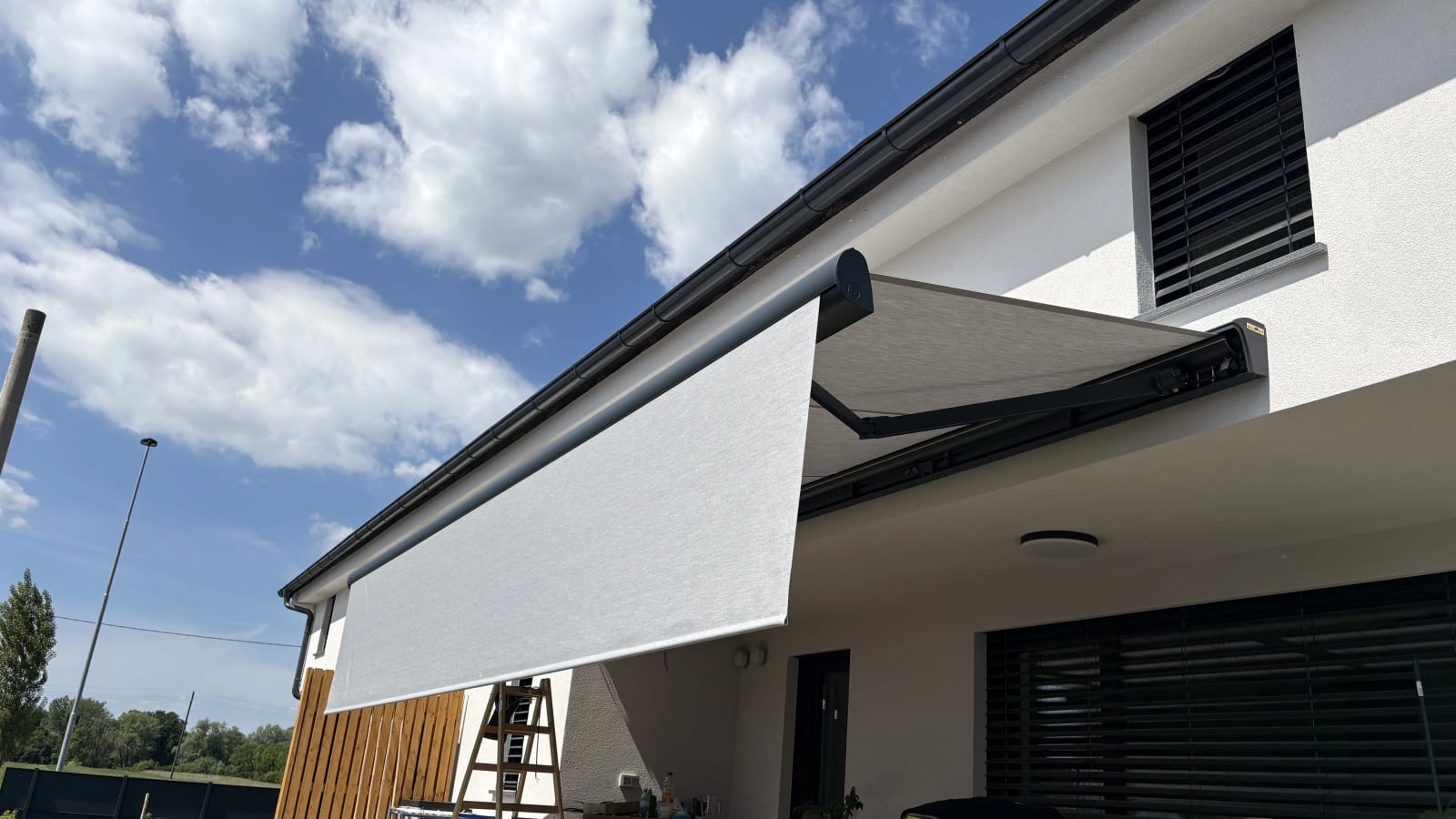
When you start looking for shade for a terrace, you quickly meet three terms that often get mixed up in conversation. An awning, a pergotenda and a bioclimatic pergola are not three grades of the same product, but three different solutions for three different situations. The difference is not only price.
Below is what each one actually is, when it is worth it, and when it would be the wrong choice. Including when we advise against the most expensive option.
Three solutions, three different logics
The shortest possible summary: an awning is fabric that extends from a cassette on the facade. A pergotenda is fabric that runs on its own load-bearing structure. A bioclimatic pergola has no fabric at all, but rotating aluminium louvres.
Almost everything else follows from that. Fabric is light, quick and affordable, but has its limits in wind and rain. Louvres last longer and do more, but cost more and stay in the roof even when you would like an open sky.
Awning: the quickest route to shade
A classic awning is fixed to the facade and extends when you need it. When you do not, it disappears into the cassette and you barely notice it from the yard. That is its biggest strength. Shade in summer, gone in winter.
An awning makes sense when your terrace sits against the house, you mainly need protection from sun, and you do not need the space to work in rain and wind. For many houses that is entirely enough and there is no reason to pay for more.
Its limits show up in weather. Fabric is sensitive to wind, so motorised versions retract in a strong gust. This is exactly why a wind sensor makes sense, as it puts the awning away even when you are not home. On a recent project in Ljubljana we installed such a version over a terrace where afternoon sun was the only real problem. You can see the result in our references.
Pergotenda: fabric on its own structure
The pergotenda sits in between and is often the most misunderstood. It differs from a classic awning in that the fabric does not hang free, but runs on its own load-bearing structure with posts or guide rails.
That brings two things. The structure withstands considerably more than a plain awning, so a pergotenda still works when an awning would have to retract. And because the fabric folds away completely, you get a fully open sky above the terrace, which a bioclimatic pergola cannot offer.
If having an open view upwards in summer matters to you, the pergotenda is the only one of the three that truly delivers it. More on the awnings and pergotenda page.
Bioclimatic pergola: louvres instead of fabric
A bioclimatic pergola has no fabric. Its roof has rotating aluminium louvres that you turn to any position between open and closed. When closed, they meet with seals and the roof becomes watertight, with water draining through concealed gutters in the posts.
The advantage over both fabric solutions is versatility. You are not choosing between shade and rain, you regulate both at once, and ventilation on top of that. Aluminium withstands far more than textile and needs no yearly maintenance.
There are two drawbacks and it is fair to name them. The price is higher, and the sky above the terrace stays divided by the louvres even when they are fully open. The exception is the Brustor B600 S Cabrio, where the louvres also fold away. How a pergola works is covered in detail in our basic guide.
Side by side
| Awning | Pergotenda | Bioclimatic pergola | |
|---|---|---|---|
| Roof | Fabric from a cassette | Fabric on a structure | Rotating aluminium louvres |
| Open sky | Yes, when retracted | Yes, when folded away | No, except on models with folding louvres |
| Use in rain | Limited | Good | Very good |
| Wind resistance | Lowest | Medium to high | Highest |
| Maintenance | Fabric cleaning | Fabric cleaning | Practically none |
| Price range | Lowest | Middle | Highest |
Which one suits your situation
| Your situation | The direction we recommend |
|---|---|
| You mainly need summer shade, terrace against the house | Awning |
| You want an open sky but also shelter from rain | Pergotenda |
| You want to use the terrace from spring into late autumn | Bioclimatic pergola |
| The location is exposed to wind | Bioclimatic pergola, an awning is out |
| Heavy winters, snow stays on the roof | Bioclimatic pergola with a reinforced louvre profile |
| Limited budget and modest expectations about weather | Awning with a wind sensor |
ZIP screen or a plain screen blind?
Whichever solution you choose, the question of side protection comes up sooner or later. Here sits a difference few people explain, even though it affects both the price and how well the blind performs.
A plain screen blind has fabric hanging free between guide rails, or without them. It works well in calm weather, but in wind the fabric flaps and can pull out of position.
A ZIP screen has the edge of the fabric welded into a profile that runs inside the side rails, much like a zipper. The fabric therefore stays taut in wind, does not flap and seals better at the sides. It costs more, but in exposed locations it is the only one that does the job long term.
If someone offers you screen blinds, it is worth asking which of the two versions they mean. The price difference has a reason. More on the ZIP screen blinds page.
What usually decides it in practice
From experience, people arrive with a solution in mind and then one of these three things changes the decision.
How often you will actually use the terrace. If you use it every day from April to October, a higher investment spreads over a lot of hours. If you go outside ten times a year, an awning is a perfectly sensible choice.
Which way the terrace faces. A west-facing terrace with afternoon sun has a different problem from a north-facing one that is cold and windy. The first is solved by shade, the second by protection at the sides.
What you will want to add in five years. Many people start with a basic version and later want blinds or lighting. Say so upfront and the right structure gets prepared, making the upgrade simple. Leave it out and it can be expensive or impossible.
How to decide without guessing
The most useful next step is not choosing a product but taking measurements. Once we see the dimensions of the terrace, its orientation and how you want to use it, the choice between the three solutions is usually quick to make.
Send the dimensions and a few photos of the terrace. Within 48 hours you get a non-binding calculation with a proposal that genuinely fits your situation, even if that means advising against the more expensive option. What drives the price is explained in our pricing guide.